

Cordera Apples
The Crisp Apple That Also Holds Up in a Pie
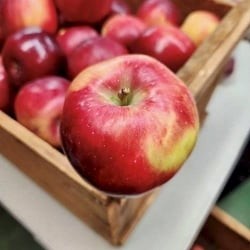
A modern New York apple from Cornell AgriTech, grown in our own orchard. It takes the loud crunch from its Honeycrisp side and adds the tartness and structure that side is short of — so one apple snacks and bakes.
Not listed above? The crop is still on the tree — see Harvest Times, or Ready to Ship for what is leaving the farm today.
Cordera: A Honeycrisp Child That Can Also Bake
Most very crisp apples are one-trick apples. They are wonderful in the hand and they collapse the moment they meet an oven. Cordera is the uncommon one that does both.
It is a modern New York apple from Cornell AgriTech at Geneva, introduced in 2020, from a cross with Honeycrisp. The crunch is the family resemblance — coarse, open-grained, the kind you hear. What it adds is tartness and structure, which is exactly what Honeycrisp is short of in a pie.
And it has the best name in the orchard, which is a story further down.
Cordera Apples at a Glance
Origin
Cornell AgriTech
Geneva, New York
Introduced 2020
Parentage
From a cross with
Honeycrisp
Second parent not published
Flavor
Sweet and tart together
Clean, bright finish
Plenty of juice
Texture
Firm • Properly crisp
Coarse, open grain
Holds its shape when cooked
Appearance
Red skin
Light striping or blush
Colour varies with sun
Best Known For
Eating and baking
A rare double
Still hard to find
Best Uses for Cordera Apples
Fresh Eating & Lunchboxes
Firm enough to travel without bruising and crisp enough to still be worth eating at noon. Eat it cold — chilling sharpens both the crunch and the tart edge.
Pies, Tarts & Crisps
The slices keep their edges instead of going to sauce, and there is enough acidity that the filling does not taste flat. Cut them thick.
Salads & Cheese Boards
The crunch survives a dressing and the tartness stands up to a strong cheese — aged cheddar, blue, a firm alpine.
Sauce & Savory Cooking
A bright, tart-leaning sauce; blend with McIntosh for the classic soft one. Good in a slaw and alongside pork.
From Geneva, and Named for a Person
Cornell AgriTech at Geneva has been putting apples on American tables for more than a century. Macoun came from there. So did Cortland and Empire. Few places have shaped what a northeastern apple tastes like more than this one station.
Cordera was introduced in 2020, from a cross with Honeycrisp. That is the part of its parentage that is on the record. We have found no published record of the second parent, so this page does not name one.
What follows a cross is patience. Seedlings are grown out and watched, nearly all are discarded, and the rare promising one is grafted and watched again across many seasons before it earns a name. Apple work is measured in careers rather than quarters, which makes the choice of name rather touching.
The Best Name in the Orchard
Cordera is Spanish for a young female sheep — a ewe lamb.
The apple is named for Robert Lamb, a pomologist whose work runs through decades of the Geneva programme's releases. It is a pun and a thank-you in the same word, and it is a great deal more thought than most varieties get. Plenty of apples are named after a place, or a person, or nothing much at all. Very few are named after a person twice over.
It is a New York apple with a Spanish word for a name, and no connection to Spain whatsoever.
Flavor, Texture and Appearance
Sweetness and tartness arrive together rather than one after the other, and there is a lot of juice behind them. It is not a sugary apple and it is not a sharp one; it lands in the middle deliberately. If you find Fuji too sweet and Granny Smith too green, this is the apple that sits between them.
The texture is where the parentage shows. Firm, properly crisp, with a coarse open grain that snaps rather than yields — the loud kind of crunch. It is a tighter bite than Honeycrisp, which is looser and more explosive, and that tighter structure is why it survives an oven.
The skin is red, commonly with light striping or a blush rather than a flat uniform coat. Colour tracks how much sun an apple caught rather than how ripe it is, so a paler one from the shaded side of the tree is the same apple. Eat the skin: most of the fiber is in it and just under it.
Harvest, Buying and Availability
Cordera is a fall apple. Maturity moves with the weather, the orchard and the crop load, so the expected ship date on the product above and the live listings are the guides worth trusting for this season. We would rather give you a date that moves than pick before the apple is ready.
It is a recent release and not widely planted, so it is not a supermarket apple. That is most of the reason people end up on this page looking for it.
See Harvest Times for where the season stands, or Ready to Ship for what is leaving the farm today. An Apple Mixer is the easy way to taste a new apple against ones you already know.
Storage and Handling at Home
Refrigerate them, promptly. The crisper drawer is the right place because it holds humidity, and moisture loss is what turns a crisp apple limp. A week on the counter costs more crispness than a month in the fridge.
Keep them away from strongly flavoured foods — apples take on smells, and they give off a ripening gas that hurries vegetables nearby. Wash under cool running water shortly before eating rather than before storing. Set any bruised fruit aside and use it first; one soft apple will bring on the ones touching it.
Cordera holds well for a fall apple, but it is not a spring keeper. If you want fruit that lasts until April, GoldRush and EverCrisp® are the ones.
Cordera Apple Nutrition Facts
According to USDA figures for a raw apple with skin, per 100 grams: 52 calories, 13.81 g carbohydrate, 10.39 g sugars, 2.4 g dietary fiber, 4.6 mg vitamin C and 107 mg potassium. Source: USDA FoodData Central, Apples, raw, with skin (FDC 171688).
USDA does not publish a separate analysis for this variety, so this table describes a typical medium raw apple rather than a laboratory analysis of Cordera. Most of the fiber sits in and just under the skin.
Full nutrition table (per 100 g and by apple size)
| Per 100 g | Small (~130 g) | Medium (~165 g) | Large (~200 g) | |
|---|---|---|---|---|
| Calories | 52 kcal | ~68 | ~86 | ~104 |
| Total carbohydrate | 13.81 g | ~18 g | ~23 g | ~28 g |
| Sugars | 10.39 g | ~14 g | ~17 g | ~21 g |
| Dietary fiber | 2.4 g | ~3.1 g | ~4.0 g | ~4.8 g |
| Protein | 0.26 g | ~0.3 g | ~0.4 g | ~0.5 g |
| Fat | 0.17 g | ~0.2 g | ~0.3 g | ~0.3 g |
| Vitamin C | 4.6 mg | ~6.0 mg | ~7.6 mg | ~9.2 mg |
| Potassium | 107 mg | ~139 mg | ~177 mg | ~214 mg |
| Water | 85.56 g | ~111 g | ~141 g | ~171 g |
Apple size varies a great deal. Treat the scaled columns as a guide rather than a measurement of the apple in your hand.
Cordera Compared with Other Apples
| Variety | Flavor | Texture | Best Known For | Cordera Connection |
|---|---|---|---|---|
| Cordera | Sweet and tart together, bright | Firm, coarse-grained, very crisp | Eating and baking | — |
| Honeycrisp | Sweeter, clean | Explosively crisp, looser grain | Premium fresh eating | Cordera’s parent |
| SnapDragon® | Sweet, a little spicy | Very crisp | Fresh eating | Another Geneva apple with Honeycrisp behind it |
| RubyFrost® | Sharply sweet-tart | Very firm, juicy | Late season, long keeping | Geneva stablemate; tarter and later |
| Macoun | Intensely aromatic, sweet-tart | Tender-crisp, very juicy | Fresh fall eating | Geneva classic; softer, shorter season |
| Cortland | Mildly tart, McIntosh character | Crisp-tender | Salads, slow to brown | Geneva classic; milder and softer |
| Empire | Balanced sweet-tart | Firm, crisp | Snacking and storage | Geneva apple, but McIntosh family |
| Northern Spy | Tart, rich, complex | Firm, coarse | Pie structure | The benchmark Cordera is measured against |
| Granny Smith | Sharply tart, green | Very firm | Baking and tart eating | Considerably sharper |
Cordera Recipes & Kitchen Uses

The useful thing about cooking with Cordera is that you can stop compensating. Most apple recipes are written around an apple with some acidity in it, and most modern crisp apples do not have any — so you end up adding lemon to a pie filling to stop it tasting flat. This one brings its own.
Single-Variety Cordera Pie
The point of the apple, in one dish
Ingredients
- 6 Cordera apples, peeled and sliced thick
- 1/3 cup sugar — taste a slice first
- 3 tablespoons flour or tapioca starch
- 1 teaspoon cinnamon
- A pinch of salt
- A tablespoon of butter, to dot
- Double-crust pie dough
Directions
- Heat the oven to 425°F.
- Cut the slices thicker than feels right — a quarter-inch or better. Cordera holds, so thick slices stay slices.
- Toss with the sugar, flour, cinnamon and salt. Taste a raw slice before committing to the sugar; you will probably want less than the recipe you are used to.
- Fill the crust, dot with butter, put the top on and cut generous vents. This is a juicy apple.
- Bake at 425°F for 20 minutes, then 375°F for another 35 to 45, until the juice bubbles thickly through the vents.
- Cool at least two hours. A hot pie runs; a cool one slices.
Why it works: Most crisp modern apples need a firmer apple blended in or the filling turns to sauce. Cordera does not. It is the rare variety where a single-variety pie is the best version.
Cordera & Northern Spy Pie, for the traditionalist
If you want the classic, this is the blend
Ingredients
- 3 Cordera apples, peeled and sliced thick
- 3 Northern Spy apples, peeled and sliced thick
- 1/3 cup sugar
- 3 tablespoons flour
- 1 teaspoon cinnamon
- 1 tablespoon lemon juice
- A pinch of salt
- Double-crust pie dough
Directions
- Heat the oven to 425°F.
- Toss both apples with the lemon first, then the dry ingredients.
- Fill, top, vent generously.
- Bake at 425°F for 20 minutes, then 375°F for 35 to 45 more.
- Cool thoroughly before slicing.
Why it works: Northern Spy is the structural benchmark and brings a deeper, more complex tartness. Cordera brings juice and a brighter edge. You also get to eat the leftover Cordera raw while you work, which is not true of a Spy.
Two-Apple Sauce
Cordera for brightness, McIntosh for the perfume
Ingredients
- 4 Cordera apples, cored and chopped
- 4 McIntosh apples, cored and chopped
- 1/2 cup water or cider
- 1/2 teaspoon cinnamon
- A pinch of salt
Directions
- Leave the peels on for colour and body, or take them off for a smooth sauce.
- Everything into a heavy pot over medium-low heat, lid on.
- Cook 20 to 25 minutes, stirring now and then, until the McIntosh collapses.
- Mash for a rustic sauce or pass through a food mill for a smooth one.
- Taste before adding any sugar. It will very likely not need it.
Why it works: McIntosh goes to sauce on its own and brings the aroma; Cordera holds a little texture and keeps the whole thing bright instead of flat.
Four More, Briefly
No recipe needed — just the idea
- Apple and sharp cheddar board. Thick wedges, skin on, against an aged cheddar. This apple can take a strong cheese; a sweet one cannot.
- Cabbage and apple slaw. Matchsticks tossed in cider vinegar before they meet the cabbage. The crunch survives the dressing.
- Apple crisp. Thick slices, oat and brown sugar topping, 375°F until bubbling. The fruit stays in pieces under the crumble.
- Dried rings. An eighth of an inch thick, dried low and slow. No sugar needed.
Why Cordera Is Worth Ordering
The last twenty years of apple work have been very good at producing crunch and not much else. A row of modern varieties will give you the texture people ask for and a flavour that mostly amounts to sweet.
Cordera kept the crunch and brought the acid back. That sounds like a small thing and it is the whole difference between an apple you snack on and an apple you cook with. It means one variety in the bag does the work of two, and it means a pie made from it tastes of apple rather than of sugar and cinnamon.
It is new, it is not widely planted, and it is not in a supermarket. Which is the other reason to order it while there is some.
Cordera Blog & Shipping Resources
More Questions About Cordera Apples
Cordera Basics (10)
What kind of apple is a Cordera?
Cordera is a modern New York apple from Cornell AgriTech at Geneva, introduced in 2020. It comes from a cross with Honeycrisp, and it eats like it — crisp, loud, juicy, with a clean sweet-tart finish.
What do Cordera apples taste like?
Bright and balanced. Sweetness and tartness arrive together rather than one after the other, and there is a lot of juice behind them.
It is not a sugary apple and it is not a sharp one. It lands in the middle on purpose.
Is Cordera sweet or tart?
Both, in roughly equal measure. If you find Fuji too sweet and Granny Smith too sharp, this is the apple that sits between them.
What is Cordera's texture like?
Firm and properly crisp, with a coarse, open grain that snaps rather than yields. That is the Honeycrisp side showing.
It also holds its shape in the oven, which a lot of very crisp apples do not.
What color is a Cordera apple?
Red, often with light striping or a softer blush rather than a flat, uniform coat. Colour varies from apple to apple with how much sun each one caught.
Why is it called Cordera?
Because cordera is Spanish for a young female sheep — a ewe lamb. Cornell named the apple for Robert Lamb, a pomologist whose work runs through decades of the programme's releases.
It is a pun and a thank-you at the same time, which is a better naming story than most apples get.
How do you pronounce it?
cor-DAIR-uh. Nobody will mind if you say cor-DER-uh.
Is Cordera a new apple?
Yes by apple standards — introduced in 2020. Most of the apples in a supermarket are older than most of the people buying them, so a variety released this decade is genuinely new.
Is Cordera an heirloom?
No. It is a modern named variety with a documented origin at a research station. An heirloom is generally an old variety of uncertain or chance parentage — Baldwin or Pound Sweet.
What is Cordera best known for?
Being a Honeycrisp-family apple that behaves in a kitchen. It keeps the crunch people want from that side of the family and adds enough structure to survive a pie.
Origin, Name & History (10)
Where does Cordera come from?
When was Cordera introduced?
2020.
Who was Robert Lamb?
A pomologist at Cornell whose work runs through decades of the programme's apple releases. Naming a variety cordera — Spanish for a ewe lamb — is the station's tribute to him.
Is Cordera related to Honeycrisp?
Directly. It came from a cross with Honeycrisp, and the crunch is the family resemblance.
What is Cordera's other parent?
We have found no published record of it. The Honeycrisp side is documented; the other side is not, so this page leaves it open rather than guessing.
If Cornell publishes it, it will appear here.
Is Cordera the same as Honeycrisp?
No — it is a child, not a version. Apple seedlings never come true to the parent, which is why a promising one gets propagated by grafting rather than by seed.
Cordera is tarter and more structured than Honeycrisp, with a tighter bite.
Why do research stations keep making new apples?
Because an apple has to do several things at once — taste good, travel, keep, and grow reliably in a real orchard — and no single variety has ever done all of them perfectly.
Each release is an attempt to hold on to what people liked about the last one and fix what they did not.
How long does it take to make an apple like this?
Decades, usually. A cross is made, the seedlings are grown out and watched, nearly all are discarded, and the rare promising one is grafted and watched again across many seasons before it earns a name.
Apple work is measured in careers rather than quarters.
Is Cordera genetically modified?
No. It came from an ordinary cross — pollen from one tree onto the blossom of another — followed by selection and grafting, which is how named apple varieties have been made for centuries.
Are Cornell apples only grown in New York?
No, but New York is where they were developed and where they are most at home. Ours are grown in our own New York orchard.
Taste, Texture & Appearance (11)
How crisp is Cordera?
Very. It has the coarse, open-grained crunch that the Honeycrisp side of the family is known for — the kind you hear.
Is Cordera juicy?
Yes, noticeably so. Cut one over a board with a lip.
Is Cordera as sweet as Honeycrisp?
Not quite. Honeycrisp leans sweeter and softer in its balance; Cordera keeps more tartness in play, which is what makes it the better cooking apple of the two.
Does Cordera have a strong aroma?
A clean, fresh apple smell rather than a perfumed one. If you want an apple you can smell across a room, Macoun is the one.
What does the skin look like?
Red, commonly with light striping or a blush rather than a solid uniform coat. Some apples colour up more than others depending on where they sat on the tree.
Is the skin thick or tough?
Thin enough not to be a nuisance, and worth eating — most of the fiber sits in and just under it.
Does a redder Cordera taste better?
No. Colour tracks sun exposure more than ripeness. A paler apple from the shaded side of the tree is the same apple.
Does Cordera taste different early or late in the season?
Yes, as every apple does. Fruit picked early eats firmer and sharper; later fruit runs sweeter and softer. Crop load and weather move it too.
Is it better cold or at room temperature?
Cold, for this one. Chilling sharpens the crispness and the tart edge, which is where Cordera is at its best.
Does Cordera go soft quickly?
Not if it is kept cold. It is a firm apple and it holds, but like any apple it loses crispness faster on a counter than in a crisper drawer.
How big are Cordera apples?
Size varies with the season and the crop, and we pack what the orchard gives us rather than sorting to a single target. The package description says what you are getting.
Best Uses, Cooking & Recipes (12)
What is Cordera best for?
It is unusually good at two jobs that usually need two apples: eating out of hand, and baking.
Most very crisp apples collapse in the oven. This one holds its shape.
Is Cordera good for pie?
Yes, and it is one of the better modern apples for it. The slices keep their edges instead of going to sauce, and there is enough acidity that the filling does not taste flat.
Cut the slices thick and vent the top crust generously — this is a juicy apple.
Is Cordera good for apple crisp?
Very. Same reason as the pie: the fruit stays in pieces under the topping rather than turning to mush.
Does Cordera make good applesauce?
It makes a bright, tart-leaning sauce. If you want the classic soft, aromatic sauce, blend it with McIntosh, which collapses readily and brings the perfume.
Is Cordera good in salads?
Yes. The crunch survives dressing and the tartness stands up to cheese and nuts.
Is Cordera a good lunchbox apple?
A very good one. Firm enough to travel without bruising and crisp enough to still be worth eating at noon.
Do I need to adjust the sugar when baking with Cordera?
Less than with a sweet apple, and probably not at all. It carries its own acidity, which is what most recipes are written around.
Taste a slice before you commit either way.
Should I peel Cordera for baking?
For a pie or a formal tart, peel it. For a crisp or a rustic sauce, leave the skin on — it adds colour and body.
Can I use Cordera in savory cooking?
Yes. It is good in a slaw, with pork, and in a chicken or tuna salad, where its tartness does more work than a sweet apple would.
What cheeses go with Cordera?
It can take a stronger cheese than a sweet apple can. Aged cheddar, blue, a firm alpine cheese — all work, because the apple pushes back.
Can I dry Cordera apples?
Yes. Slice thin and even so the rings dry at the same rate. No sugar needed.
Does Cordera brown quickly when cut?
Like most apples, it will dull over time on a plate. A squeeze of lemon slows it, and thick skin-on wedges hold better than thin peeled slices.
If you specifically need slices that still look freshly cut an hour later, SnowSweet is the variety selected for it.
Harvest & Season (7)
When are Cordera apples picked?
In the fall. For this crop, the expected ship date on the product above and the live listings are the guides worth trusting — they reflect this season rather than a general calendar.
Does Cordera ripen at the same time every year?
No. Maturity moves with the weather, the orchard and the crop load. A cool stretch slows it, a warm one hurries it.
How do I know when Cordera is ready to order?
If a package shows as available above, the fruit is ready. If nothing is listed, the crop is still on the tree.
See Harvest Times for where the season stands, or Ready to Ship for what is leaving the farm today.
Why is the ship date only an estimate?
Because weather moves fruit, and rain can stop picking outright for days. We would rather give you a date that moves than pick before the apple is ready.
Is Cordera a good keeper?
It holds well in the refrigerator for a fall apple. It is not a spring keeper — if you want fruit that lasts until April, GoldRush and EverCrisp® are the ones.
Is Cordera hard to find?
It is new and not widely planted, so it is not a supermarket apple. That is most of why people end up here looking for it.
What should I buy if Cordera is sold out?
For the same crisp, sweet-tart balance: Honeycrisp, SnapDragon® or RubyFrost®, subject to the season.
For a firmer baking apple, Northern Spy.
Storage, Handling & Shipping (10)
How should I store Cordera apples?
In the refrigerator, promptly. The crisper drawer is best because it holds humidity, and moisture loss is what turns a crisp apple limp.
A week on the counter costs more crispness than a month in the fridge.
Why does cold matter so much?
Apples keep ripening after picking, and cold slows that more than anything else you can do at home.
Should I wash them before storing?
No — wash just before eating. Surface moisture in storage encourages spoilage. Cool running water is all that is needed.
Can I store apples with other food?
Keep them away from strongly flavoured foods; apples take on smells. They also give off a ripening gas that hurries vegetables nearby, so a little separation helps both.
What should I do with a bruised apple?
Use it first and keep it apart from the rest — one soft apple will bring on the ones touching it. A bruise is not a spoiled apple; cut the mark out and it is fine for a crisp or sauce.
How long will they last?
Weeks in a refrigerator, treated well. Judge by the apple rather than a date: a Cordera that still snaps is still good.
Can I freeze Cordera apples?
For cooking, yes. Peel, slice and freeze in a single layer before bagging; they hold for months for pies, crisps and sauce. Freezing will not preserve the fresh-eating texture.
How do apples travel in the mail?
Better than people expect — they are picked firm and packed to stay put. What they do not like is heat sitting on a truck, which is why timing matters more than distance. See Shipping Information.
My apples arrived cold. Is that a problem?
Not at all. Cold is where you want them. Move them into the refrigerator.
Can Cordera be sent as a gift?
Yes, when a suitable package is showing above. Gift boxes give each apple more individual protection and arrive presented properly; a bushel case is built for value rather than presentation.
Cordera vs. Other Apples (9)
Cordera or Honeycrisp?
Cordera is its child and the tarter, tighter of the two. Honeycrisp is sweeter with a looser, more explosive crunch.
Honeycrisp for eating. Cordera if you also want to bake with it.
Cordera or SnapDragon?
Both are modern Cornell apples with Honeycrisp behind them. SnapDragon® leans sweeter and spicier; Cordera keeps more tartness.
Cordera or RubyFrost?
RubyFrost® is the tarter, later apple and the better keeper. Cordera is the more balanced one and arrives earlier.
Cordera or Macoun?
Different pleasures. Macoun is intensely aromatic and tender-crisp, a fresh-eating apple with a short season. Cordera is firmer, tarter and far more useful in an oven.
Cordera or Cortland?
Cortland is milder and softer, and its party trick is staying white in a salad. Cordera is crisper and brighter.
Cordera or Northern Spy for pie?
Northern Spy is still the structural benchmark — firmer, tarter, the classic. Cordera is the one you can also eat raw out of the bowl while you make it.
Half and half is an excellent pie.
Cordera or Granny Smith?
Granny Smith is considerably sharper and greener in flavour. Cordera is balanced, not sour.
Is Cordera like Empire?
They share a home — both are Cornell apples — but Empire is a McIntosh-family apple, softer and more aromatic. Cordera is the firmer, crunchier one.
Which other Cornell apples should I try?
Macoun, Cortland, Empire, SnapDragon® and RubyFrost® are all from Geneva. An Apple Mixer is the easy way to line a few up.
Buying & Ordering (7)
How are Cordera apples sold?
By the package sizes showing above — gift boxes, bushel cases and mixers, depending on the crop and the time of year.
Can I mix Cordera with other varieties?
Yes — that is what the Apple Mixer is for, and it is the best way to taste a new apple against ones you already know.
Are these the same apples you sell at the farm?
Yes. What ships is what we pick.
Are your apples certified organic?
No, ours are not certified organic. We use the best agricultural practices we can, but we do not hold organic certification and we are not going to imply otherwise.
Do you ship to Arizona and California?
We do, and there are pages built specifically for those destinations because the timing differs. Check the listings above for what is available to your address.
Can you include a gift message?
Yes. There is a message field on the order, and we will include it with the box.
Who do I call with a question?
Contact us, or telephone 518-695-4517. A person answers.
Nutrition & the Kitchen Facts (6)
What is in a Cordera apple?
An apple is a satisfying low-calorie snack with useful fiber. According to USDA figures for a medium raw apple, that is roughly 86 calories and about 4 grams of fiber. The full table is above.
How much fiber is in an apple?
USDA figures for a raw apple with skin give about 2.4 grams per 100 grams — roughly 4 grams in a medium apple. Most of it sits in and just under the skin.
Is the nutrition figure specific to Cordera?
No, and we will not pretend otherwise. USDA does not publish a separate analysis for this variety, so the table describes a typical medium raw apple rather than a laboratory analysis of Cordera.
Does a tarter apple have less sugar?
Not reliably. How sweet an apple tastes depends on the balance between its sugar and its acid, not sugar alone. A tart apple and a sweet one can be closer in sugar than they taste.
Do apples lose nutrition in storage?
Some vitamin C declines over months. Fiber and the minerals do not meaningfully change.
Is it better to eat the apple or drink the juice?
Eat the apple, if the choice is yours. Juicing leaves the fiber behind, and the fiber is a good part of the point.
Growing & the Tree (5)
Can I buy a Cordera tree?
We sell fruit, not trees. Cordera is a recent named release, which means propagation is licensed — a nursery needs permission to graft and sell it.
Can I grow one from a seed?
You can grow a tree. It will not be a Cordera.
Apples do not come true from seed — every pip is its own new variety, and nearly all of them are disappointing. Every Cordera tree is grafted wood traced back to the original selected seedling.
Do apple trees need a pollination partner?
Nearly all do. Apples are poor at setting fruit with their own pollen, so an orchard block needs a compatible variety flowering at the same time nearby. That is orchard planning rather than anything a shopper needs to think about.
Why do new apples cost more?
A young variety is planted in small numbers, the trees take years to come into bearing, and there is no scale behind it yet. What you are paying for is scarcity rather than a different kind of apple.
Is Cordera grown outside New York?
Not widely, so far. It is a recent Geneva release and plantings are still small. Ours are grown here.
The Name (4)
What does Cordera mean?
Cordera is Spanish for a young female sheep — a ewe lamb.
Why would an apple be named after a lamb?
Because of a person, not an animal. Cornell named it for Robert Lamb, a pomologist whose work runs through decades of the station's apple releases.
A pun and a thank-you in the same word.
Is Cordera a Spanish apple?
No. It is a New York apple with a Spanish word for a name.
Do apple names usually mean anything?
More often than you would think. Some are places, some are people, and a few — like this one — are a joke the people who made them wanted to leave behind.
Cordera Facts, Trivia & a Few Bad Jokes
Named After a Person, Twice
Cordera is Spanish for a ewe lamb. The apple honours Robert Lamb, a Cornell pomologist. The name is the tribute and the joke at once.
No Connection to Spain
It is a New York apple from Geneva with a Spanish word for a name and nothing Spanish about it.
A Honeycrisp That Behaves
It keeps the family crunch and adds the structure and acidity Honeycrisp is short of in an oven.
Geneva’s Long Shadow
The same station gave us Macoun, Cortland and Empire. Cordera joins good company.
Brand New by Apple Standards
Introduced in 2020. Most apples in a supermarket are older than most of the people buying them.
Half the Pedigree Is Public
The Honeycrisp side is on the record. We have found no published record of the second parent, so this page leaves it open.
Why was the apple named after a sheep?
Because naming it after Mr Lamb directly seemed a bit on the nose.
What do you call a Honeycrisp that learned to bake?
Cordera. Also: overqualified.
Why is Cordera so hard to find?
Everyone who has had one bought the rest of it.
What did Cordera say to Honeycrisp?
“I get my crunch from you.” Honeycrisp said “and the attitude?”
Questions about Cordera apples, package sizes or shipping? Contact us or call 518-695-4517.
Origin, introduction year, Honeycrisp parentage and the naming of the variety for pomologist Robert Lamb are as recorded by Cornell AgriTech. No published record of the second parent has been found, so it is not stated here. Harvest and availability are specific to our orchard and subject to the current crop.
