

Red Gravenstein
Denmark’s National Apple, Grown Here in New York
Some apples you keep. The Gravenstein is one you use. It comes early, it fills a kitchen with the best smell of the whole year, and it cooks down into the most fragrant sauce you will ever make. Ours is the deep-red form of that three-hundred-year-old European favorite.
Our first great apple of the year, and a short season.
See Harvest Times
or Ready to Ship.
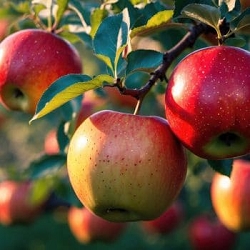
The Red Gravenstein — An Old-World Apple That Opens the Season
The Gravenstein has been grown in northern Europe since the 1600s, and it is still the apple Denmark claims as its own. It reached California with Russian settlers in the early 1800s and made Sonoma County famous. It reached New England farmhouses the ordinary way, in the grafting wood of settlers who were not about to arrive without their best cooking apple.
The Red Gravenstein is that same apple wearing a deeper coat — a red sport of the old striped original, with the identical flavor, the identical perfume and the same short, glorious late-summer season. We grow it in Eastern New York alongside the rest of our Heirloom Apple Collection.
This is an apple to eat this week, bake this weekend and freeze for January. For three or four weeks in late summer there is nothing better in the orchard, and the freezer trick means you can still be eating Gravenstein pie at Christmas.
Red Gravenstein at a Glance
Sweet and sharp at once, with an aromatic perfume that most modern apples simply do not have.
Crisp and remarkably juicy off the tree, with fine-grained flesh that breaks rather than crunches.
Deep red over a yellow-gold ground, sometimes with a little of the original striping showing through.
August into early September in our Northeast orchard, picked over several passes as the fruit comes ready.
Sauce, pies, apple butter, cider, savory cooking, fresh eating and the freezer.
A European heirloom from the 1600s, the national apple of Denmark, and a Slow Food Ark of Taste variety.
History of the Gravenstein Apple
Where did the Gravenstein apple come from?
Northern Europe, and it is genuinely old. The apple takes its name from Gråsten — Gravenstein in German — a castle town in the border country between Denmark and Germany.
Denmark, northern Germany and Italy have all been put forward as its birthplace over the years. What nobody argues about is that it was already well known and well loved in Europe long before the United States existed.
How old is the Gravenstein?
It goes back to the 1600s. That makes it one of the oldest apples anybody still plants on purpose, and far older than almost everything else in a modern orchard.
Apples that survive three hundred years survive on flavor. Nothing else keeps a variety in the ground that long.
Why is it called Gravenstein?
After the place. Gravenstein is the German name for Gråsten, and the apple was grown in the castle gardens there.
The Danes spell it Gråstenæble, the Germans Gravensteiner, and American orchards have called it Gravenstein for as long as it has been here.
Is Gravenstein really the national apple of Denmark?
It is, and the Danes are not shy about it. Gravenstein is the apple Danish families cook with, and it has been a point of national pride for generations.
It is one of the few apples anywhere that a whole country has claimed.
How did Gravenstein get to America?
By two routes, and the interesting one is the west coast. The Sonoma Gravenstein story starts at Fort Ross, the Russian settlement on the northern California coast, where settlers were planting apple trees from the 1810s.
It reached the east coast the ordinary way, in the grafting wood of settlers who were not about to arrive without their best cooking apple.
Why is Sonoma County famous for Gravensteins?
Because for the better part of a century it grew them by thousands of acres. Sebastopol built a whole local identity around the Gravenstein — a harvest fair, a highway named after it, the works.
Most of those orchards are gone now, replaced by vineyards. The apple is still celebrated there every August.
Is the Gravenstein a protected heritage variety?
The Sebastopol Gravenstein is listed on the Slow Food Ark of Taste, which is the catalogue of traditional foods worth keeping in cultivation.
That listing exists because the apple was genuinely at risk of fading out. It is the same reason we grow the rest of our Heirloom Apple Collection.
Was Gravenstein ever widely grown in the Northeast?
Yes, though never on the California scale. It was a standard farm and homestead apple across New England and New York — the early apple you had while you waited for the keepers to come in.
Old farmhouse trees turn up all over the region. If somebody in your family talked about an August apple that made the whole kitchen smell good, this was very likely it.
Where does the Red Gravenstein come in?
Somebody noticed one branch of an ordinary Gravenstein throwing fruit with deep red skin instead of the usual stripes, cut wood from it and grafted it on. That is how nearly every red version of a classic apple starts.
The fruit on that branch was still Gravenstein in every way that matters. Only the color changed.
Why don't I see Gravensteins in the supermarket?
Because it is an August apple that does not sit around, and the supermarket business is built on apples that ship far and store for months.
That is the whole reason to buy it direct. A Gravenstein is worth eating; it is just not worth warehousing.
What Do Red Gravenstein Apples Taste Like?
What does a Red Gravenstein taste like?
Sweet and sharp at the same time, with a perfume behind it that most apples simply do not have. People who grew up with them describe the flavor as more intense than a modern apple — more going on, and more of it.
It is the kind of apple that makes somebody stop mid-bite and ask what it is.
Is it sweet or tart?
What is the texture like?
Crisp and very juicy when it first comes off the tree, with a fine-grained flesh that breaks rather than crunches. It is a softer sort of crisp than a Honeycrisp.
Eat it in the first couple of weeks and you get the texture at its best.
Everybody mentions the smell. Why?
Because it is remarkable. Cut a Gravenstein open and the fragrance carries across a room — floral, a little like ripe pear, unmistakably apple.
Cook a pan of them and the whole house smells of it. That aroma is the single most-loved thing about the variety.
How juicy is it?
Very. It is a drip-down-your-wrist apple, which is part of why it makes such good juice and cider.
Eat it over a plate.
Does the flavor change through the season?
It does. The earliest fruit is sharper and greener-tasting; a week or two later the sugar comes up and the aromatics fill out.
Both versions have their fans. Cooks often prefer the early sharp ones and fresh eaters prefer the later ones.
I love Honeycrisp. Will I like this?
You will like the flavor more and the texture less. Honeycrisp is built around that explosive crunch; Gravenstein is built around aroma and balance.
Try a small box alongside your usual order and see which one you reach for.
I love Granny Smith. Will I like this?
Probably, yes. You already like an apple with backbone, and Gravenstein has that sharpness without the one-note greenness.
It is what a Granny Smith would be if somebody added perfume and sweetness to it.
What makes it taste different from a modern apple?
Modern apples are bred to be reliably sweet, reliably crisp and reliably the same. Gravenstein was never bred for any of that — it simply turned up and was good.
What you get is more character and more variation. Two Gravensteins off the same tree can taste noticeably different, and that is part of the appeal.
Red Gravenstein vs the Original Gravenstein
What is the difference between a Red Gravenstein and a Gravenstein?
The skin. The original is green-gold with broken red and orange stripes; the Red Gravenstein is a much deeper, more solid red.
Underneath the skin they are the same apple — same flavor, same perfume, same season, same uses.
So it is not a separate variety?
Not in the way a cross between two apples is. A Red Gravenstein is a Gravenstein that changed color, and every red strain of it began as one branch on somebody's tree.
Pomologists call that a sport. Gardeners call it a lucky accident.
What is a sport?
A natural change that shows up in one branch of an established tree. The fruit on that branch comes out different — usually redder, sometimes earlier — and if a grower likes it, cuttings from that branch become a new strain.
Plenty of familiar apples are sports. It is one of the oldest ways new apples arrive, and it costs nothing but a sharp eye.
Does the red one taste the same?
Yes. Anybody telling you a red sport tastes meaningfully different from its parent is telling you about the weather that season, not the apple.
The reason growers plant the red one is simply that customers pick it up.
Which should I buy?
Whichever you can get. If you want the striped, old-fashioned look, that is the original; if you want a handsome deep-red apple in a gift box, the Red Gravenstein photographs and gifts better.
What is in our boxes is the red one.
Are there other Gravenstein strains?
Several. Growers around the world have picked out their own red sports over the years, so a Gravenstein from Denmark, California and New York can look quite different while tasting the same.
It is a sign of how far the apple traveled.
Will my box say Red Gravenstein?
Yes. We label it the way we grow it.
If you were sent here looking for plain Gravenstein, you are in the right place — this is that apple, in its red form.
Red Gravenstein Harvest & Availability
When are Red Gravensteins picked?
August into early September in our part of the Northeast, give or take a week for the season. It is one of the first genuinely good apples of the year.
Check Harvest Times for where we are right now.
Why is it picked over several passes?
Because a Gravenstein tree does not ripen all at once. The fruit comes ready in waves, so the crew walks the same trees several times and takes only what is ready.
It is slower, and it is the reason the apples in your box are at their best rather than merely picked.
How long does the season last?
A few weeks, not a few months. This is an early apple with a short run, and when it is gone it is gone until next August.
If you want them, order while the page says they are shipping.
Can I order them right now?
If the size you want shows as available above, yes. Ready to Ship is the fastest way to see what is leaving the farm today.
Call 518-695-4517 or email [email protected] and we will tell you what is ready.
How soon after picking do they ship?
Quickly, and deliberately so. An early apple like this is at its best straight away, so we are not holding it back.
That is the advantage of buying from the farm rather than through a warehouse.
What happens if the season ends before my order goes out?
We call you. You will never simply be left waiting on an apple that has finished for the year — we will offer you an alternative or refund it.
Our Apple Crop Growing 2026 page shows what is coming along behind it.
Where are yours grown?
On our own farm in Eastern New York, alongside the rest of the Heirloom Apple Collection.
Small blocks, picked by hand, packed here.
Is this the first apple of your year?
How do I find out what is ready without calling?
Harvest Times tracks the season variety by variety, and Ready to Ship lists what is going out now.
Both are updated as the harvest moves.
Best Uses for Red Gravenstein Apples
What is the single best thing to do with a Red Gravenstein?
Make sauce. There is no apple that turns into applesauce more willingly or smells better doing it — it collapses into a fragrant, pale-gold sauce that needs almost nothing added.
People who grew up with Gravensteins usually mean sauce when they say they miss them.
Are they good in a pie?
Very good, and famously so. The sharpness survives the sugar and the aroma comes through the crust.
Slice them a little thicker than you would a firmer apple, and they will be fine. See Apple Pie for the method we use.
Do they hold their shape when baked?
Partly. They soften more than a Rome or a Northern Spy, which is exactly why they make such good sauce.
For a pie where you want distinct slices, mix them half and half with a firmer apple. For everything else, let them soften.
Are they good for cider?
Excellent. They are juicy, aromatic and sharp, which is the combination that makes juice taste of something.
In Denmark and northern Germany, Gravenstein juice is a product in its own right.
Are they good eaten fresh?
Yes, and in the first two weeks they are a treat. Crisp, dripping, perfumed.
Eat them while they are crisp and cook the rest. That is how this apple has always been used.
Can I make apple butter with them?
You can, and it is worth doing. The same quality that makes them break down for sauce makes them cook down beautifully for butter.
The aroma holds up through the long cook, which is not true of every apple.
Do they freeze well?
Sliced and frozen, yes — they are ideal for it. Freeze them in pie-sized bags in August and you have Gravenstein pie in January.
Frozen sauce keeps even better, and takes less room.
Can I dry them?
Yes. They dry to an intensely flavored ring, though they shrink more than a firmer apple because of all that juice.
Cut them a shade thicker than you think you need to.
Do they work in savory cooking?
They do. The sharpness cuts through pork, sausage, goose and anything rich, which is precisely how northern Europe has always used them.
A pan of Gravenstein slices alongside a roast is one of the oldest and best things you can do with this apple.
Should I peel them?
For a smooth sauce, yes. For a rustic one, leave the skins on and the red gives the sauce a pink blush that people love.
For pie, peel. For baking whole, leave them be.
Red Gravenstein Apple Nutrition
Figures for a medium apple, on standard USDA values for raw apple with the skin on.
Nutrition for one medium Red Gravenstein apple
| Nutrient | Approximate Amount |
|---|---|
| Calories | 95 |
| Total Carbohydrate | 25 g |
| Dietary Fiber | 4 g |
| Total Sugars | 19 g |
| Protein | 0.5 g |
| Total Fat | 0.3 g |
| Potassium | About 195 mg |
| Vitamin C | About 8 mg |
| Sodium | Very Low |
What is in a Red Gravenstein apple?
What you would expect from an apple — carbohydrate, fiber, a little potassium and vitamin C, almost no fat and almost no sodium.
Figures move with the size of the apple and how far along the season is.
Are the numbers different for the red one?
No. A red sport is the same apple with different skin, so treat these figures as covering both.
Size makes far more difference than color does.
How to Store Red Gravenstein Apples
How long do Red Gravensteins keep?
Weeks, not months. This is a use-it apple, and that is the honest answer.
Buy what you will eat and cook in the next few weeks, and freeze the rest as slices or sauce. Treated that way, a Gravenstein lasts all winter.
Should I refrigerate them?
Yes, and it makes a real difference. Cold slows an early apple down more than it slows a late one.
The crisper drawer, unwashed, in the bag they arrived in.
Can I leave them on the counter?
For a few days, if you like the look of them in a bowl. Any longer and you will lose the crispness that makes them worth eating fresh.
The flavor stays good well after the texture goes, so a soft one still makes excellent sauce.
What happens if I keep them too long?
They soften, and the perfume quiets down. Nothing dramatic — a soft Gravenstein is still a first-rate cooking apple.
Plenty of people deliberately let a few go that way before making sauce.
Will they keep in a cold cellar?
Better than on a counter, not as well as in a refrigerator, and nothing like as long as a proper winter keeper.
If you want an heirloom for the cellar, Black Oxford is the one to order.
Should I wash them before storing?
No. Wash them as you use them — wet apples in a bag keep worse than dry ones.
The dull bloom on the skin is the apple's own natural coating, and it wipes straight off under the tap.
Can I freeze the slices?
Yes, and for this apple it is the best trick there is. Peel, slice, toss with a little lemon juice, freeze flat in bags.
Straight into a pie from frozen. No thawing.
How do I keep the aroma?
Cold and whole. The perfume lives in the flesh and starts going the moment an apple is cut and left.
Cut them when you are ready to use them, and you will keep all of it.
Buying Red Gravenstein Apples Online
What sizes do you sell?
Gift boxes of 6, 12, 18, 25, 50 and 75 apples, plus a half bushel case for anybody who is cooking or pressing in quantity.
Everything is listed at the top of this page with current pricing.
What is the 6 count for?
Trying the apple, or sending a small thank-you. It is the least you can order and still get a proper taste of the variety.
Most people who order a 6 count in August order a bigger box in the same season.
What is the half bushel case?
The best value we sell, and the right choice if you are making sauce, butter or cider. The apples travel loose in the case rather than cushioned in a gift box, which is what keeps the price down — exactly right when they are headed for a pan.
It is listed under Bulk Cases as well.
Which size should I order?
For eating, the 12 or 18. For a household that bakes, the 25. For sauce or cider, the half bushel.
The 50 and 75 counts are for families, offices and anybody shipping to more than one address.
Do you ship nationwide?
We do. Details, timing and rates are on the Shipping page.
For a specific state or delivery date, call 518-695-4517 or email [email protected].
How are they packed?
Gift boxes are packed apple by apple in molded trays so nothing rubs, and early apples get the gentlest handling we do.
Cases are packed loose in a single layer, which is how a cooking quantity travels best.
Can I send a box as a gift?
Yes, and August is a good month to surprise somebody with fruit. Add your message at checkout and we will include it.
Gravenstein is a particularly good gift for anybody with Danish, German or Sonoma County roots.
What if something arrives damaged?
Tell us and we will put it right. Call 518-695-4517 or email [email protected] and tell us what arrived.
We would far rather hear about it than not.
Can I order a mixed box?
You can. Our Apple Mixers put several varieties in one box, which is a good way to taste Gravenstein against the rest of the early crop.
If you want a specific combination, call us and we will build it.
Red Gravenstein vs. Other Apple Varieties
| Variety | Flavor | Texture | Especially Good For | Typical Season |
|---|---|---|---|---|
| Red Gravenstein | Sweet-tart, intensely aromatic | Crisp, very juicy, fine-grained | Sauce, pies, cider, fresh eating | August – September |
| McIntosh | Sweet, aromatic | Tender, juicy | Sauce, fresh eating | September – October |
| Paula Red | Bright and tart | Crisp, breaking | Sauce, fresh eating | August |
| Zestar! | Sweet-tart, brisk | Very crisp | Fresh eating, pies | August |
| Cortland | Mild, sweet-tart | Firm, snow-white flesh | Pies, salads, platters | late September – October |
| Northern Spy | Sharp and rich | Firm, holds its shape | Pies, cider | October – November |
| Bramley | Very sharp | Breaks down completely | Cooking only | October – November |
| Baldwin | Rich, spicy-sweet | Firm and dense | Baking, cider, storage | mid – late October |
| Wolf River | Mild, mildly tart | Soft, coarse-grained | Sauce, baking whole from one giant apple | September – October |
| Honeycrisp | Sweet, balanced | Explosively crisp | Fresh eating, storage | September – October |
| Roxbury Russet | Rich, sweet-tart | Firm, russeted skin | Cider, fresh eating, keeping | October |
Red Gravenstein Apple Comparisons
Red Gravenstein vs McIntosh — how do they compare?
Both are aromatic, both soften when cooked, and both are beloved for sauce. McIntosh is the sweeter and more familiar of the two; Gravenstein is sharper and more perfumed.
If McIntosh sauce is your benchmark, Gravenstein sauce will surprise you.
Red Gravenstein vs Cortland — which for a pie?
Cortland holds its slices better and stays white when cut. Gravenstein brings more flavor and more aroma.
Use Cortland when the pie needs to look immaculate and Gravenstein when it needs to taste of apple.
Red Gravenstein vs Paula Red — both early apples?
Both arrive in August, and that is most of what they share. Paula Red is bright, tart and clean-tasting; Gravenstein is rounder and far more aromatic.
Order both in the same box if you want to understand the early season.
Red Gravenstein vs Zestar! — which is crisper?
Zestar!, comfortably. It was bred to be a crisp early apple and it delivers.
Gravenstein wins on flavor and perfume. Zestar! wins on crunch and keeps a little better.
Red Gravenstein vs Northern Spy — which is the better cooking apple?
Different jobs. Northern Spy is the pie apple that holds its shape; Gravenstein is the sauce apple that will not.
Spy is also a late apple, so in practice you cook with Gravenstein in August and Spy in November.
Red Gravenstein vs Bramley — two great cooking apples?
Both break down and both are sharp, but Bramley is sharper still and almost never eaten raw.
Gravenstein is the one you can cook with in the afternoon and eat out of hand in the evening.
Red Gravenstein vs Honeycrisp — honestly, which is better?
They are not competing. Honeycrisp is the best fresh-eating texture we grow and it keeps for months.
Gravenstein has the better aroma and is the better cooking apple. Order Honeycrisp for the fruit bowl in December and Gravenstein for the kitchen in August.
Red Gravenstein vs Baldwin — two heirlooms, which one?
Baldwin is the late, dense, keeping heirloom; Gravenstein is the early, juicy, use-it-now heirloom.
Between them they cover the year. A lot of our heirloom customers buy both.
Red Gravenstein vs Wolf River — which for sauce?
Wolf River wins on sheer volume — the apples are enormous and one of them fills a pie.
Gravenstein wins on flavor. Wolf River sauce is mild; Gravenstein sauce tastes strongly of apple.
If I like Red Gravenstein, what should I try next?
Among the heirlooms, Wagener and Kidd's Orange Red share the aromatic character.
Among the apples we grow in quantity, Macoun is the closest in spirit — perfumed, juicy and worth eating the week it arrives.
Growing Gravenstein Apple Trees
Can I grow a Gravenstein tree at home?
Yes, and it is a fine garden tree in a cool climate. It is vigorous, it blossoms early and it is a generous cropper.
We do not sell trees, but any good nursery that carries heritage varieties will have it.
Does it need another apple tree nearby?
Yes, and more than most. Gravenstein will not set a crop on its own, so plan on another variety flowering at the same time within reach of the bees.
Because Gravenstein blossoms early, pick an early-flowering partner.
Can a Gravenstein pollinate my other trees?
No, and this is the one genuinely odd thing about the variety. Gravenstein is a triploid — three sets of chromosomes where most apples carry two — and its own pollen will not reliably do the job for anybody, itself included.
So a Gravenstein needs two other varieties nearby in practice — one to pollinate it, and the trees you were relying on it to pollinate need a different partner.
How big does the tree get?
On a standard rootstock, large and long-lived. On a dwarfing stock it stays pickable from the ground.
The old farmhouse Gravensteins were full-sized trees, which is why so many of them are still standing.
Does it crop every year?
It has a tendency to crop heavily one year and lightly the next. Thinning the fruit hard in the heavy year evens it out considerably.
It is a well-known habit of the variety and worth planning around.
What climate suits it?
Cool summers and a proper winter. It does well in New England, New York, the Pacific Northwest and coastal northern California — and, of course, in the Baltic climate it came from.
Hot late summers are what it likes least.
When does it blossom?
Early, which is both its charm and its risk. An early blossom means an early apple, but it also means a late frost can catch it.
In a sheltered site that is rarely a problem.
Is it a good first tree for a beginner?
It is a rewarding one, as long as you know going in that it needs company to set fruit and will not return the favor.
If you want something simpler, a self-fertile variety is the easier start.
Red Gravenstein Apple Recipes
Ingredients
- 4 pounds Red Gravenstein apples, quartered and cored
- 1/2 cup water or cider
- 2 tablespoons sugar, or none at all
- 1 strip of lemon peel
- A pinch of salt
Directions
- Leave the skins on if you want a pink, rustic sauce; peel them for a smooth pale one.
- Put the apples, water, lemon peel and salt in a heavy pan over medium heat.
- Cover and cook 20 to 25 minutes, stirring now and then, until the apples collapse.
- Fish out the lemon peel. Mash for a rough sauce, or pass it through a food mill for a smooth one.
- Taste before you add any sugar. A good Gravenstein usually needs none.
Apple Filling
- 8 medium Red Gravenstein apples, peeled, cored and sliced thick
- 3/4 cup sugar
- 3 tablespoons flour
- 1 teaspoon cinnamon
- 1/4 teaspoon freshly grated nutmeg
- 1 tablespoon lemon juice
- Pastry for a double crust
Directions
- Toss the apples with the sugar, flour, spices and lemon juice.
- Pile them into a pastry-lined deep dish — they will settle as they bake.
- Lid the pie, cut vents, and brush the top with milk or cream.
- Bake at 400°F for 20 minutes, then drop to 350°F for 35 to 45 minutes more.
- Rest it a full hour before cutting. Slice them thick and they hold; slice them thin and you get something closer to a sauce pie, which is also very good.
- Freeze the sliced apples in August and this works just as well in December.
Ingredients
- 4 thick pork chops or a small pork loin
- 3 Red Gravenstein apples, cored and cut in thick wedges
- 1 onion, sliced
- 1 tablespoon butter
- A splash of cider
- Sage, salt and pepper
Directions
- Brown the pork hard on both sides in the butter and set it aside.
- Soften the onion in the same pan, then add the apple wedges and the sage.
- Return the pork, add the cider, cover and cook gently until the pork is done and the apples have half collapsed.
- The apples become the sauce. This is the oldest and best thing northern Europe does with this fruit.
More Questions About Red Gravenstein Apples
Is Red Gravenstein an heirloom apple?
Thoroughly. It predates almost every apple in a supermarket by two hundred years and more.
It sits in our Heirloom Apple Collection alongside the other old varieties we have kept in the ground.
How do you pronounce Gravenstein?
GRAH-ven-styne is the usual American pronunciation, and nobody will correct you.
The Danish Gråsten sounds closer to GRAW-sten.
Is Gråsten the same apple?
Yes — same apple, Danish name. Gråstenæble simply means Gråsten apple.
German labels will say Gravensteiner. All the same fruit.
What else is in the Heirloom Apple Collection?
A collection of varieties you will not see in a supermarket — Roxbury Russet, Black Oxford, Blue Pearmain, Wolf River, Bramley and more.
The whole list is on the Heirloom Apple Collection page. If you like Red Gravenstein, that is the place to go next.
Why do heirloom apples cost more than supermarket apples?
Small plantings, hand picking, uneven fruit and no volume buyer. A supermarket apple is priced on millions of bushels and a national distribution network; an heirloom is not.
What you get for it is a flavor and a history the volume varieties simply do not have.
How many Red Gravensteins are in a peck?
Roughly 30 to 36, depending on how the fruit sizes that year. A peck is about 10 to 12 pounds.
That is a good batch of sauce with plenty left over.
Do they brown quickly once cut?
At about the normal rate for an apple. A squeeze of lemon keeps slices bright on a platter.
If you want an apple that holds its color, Cortland is the one — its white flesh is famously slow to brown.
Are they good for children?
Very. They are juicy and sweet enough to win over a child who finds a tart apple hard work, and easy to cut into wedges for a lunchbox.
The 6 count is a good way to test that theory.
What does the skin look like?
Deep red over a yellow-gold ground, sometimes with a little striping still showing through. No two are quite alike.
There is often a dusty bloom on the skin — that is the apple's own natural coating, a good sign, and it polishes off with a cloth.
Are they all the same size?
No, and an heirloom never is. Gravensteins run medium to large with real variation from tree to tree.
We grade the gift boxes so the fruit in a box matches; the cases are more mixed.
What color is the flesh?
Creamy white to pale yellow, fine-grained and very juicy.
In a rustic sauce made with the skins on, that pale flesh takes up a pretty pink from the red skin.
When is the best time to order?
As soon as the page says they are shipping. This is a short season and the fruit season, so the sooner they leave the farm the better they arrive.
Harvest Times will tell you where we are.
Can I buy a Gravenstein tree from you?
We are an orchard rather than a nursery, so no. Any nursery specializing in heritage varieties will carry it.
If you want to taste one first, order a 6 count.
Do you sell them by the bushel?
A half bushel case is what we list for this variety. For a full bushel, or for anything larger, call 518-695-4517 and we will sort it out.
Our Bulk Cases page has the rest of the case sizes.
Is this apple related to any of the others you grow?
Not closely. Gravenstein arrived here already centuries old, rather than as a parent or child of the American varieties in our orchard.
It is its own thing, which is part of why it tastes unlike anything else we pick.
What is a Gravenstein at its best?
A day or two off the tree, cold from the refrigerator, eaten over a plate. For three or four weeks in late summer it is the best apple in the orchard.
Close behind that: a pan of them cooking, with the windows open.
Can I use them straight from the box?
Yes. Give them a rinse and go. They arrive ready to eat and ready to cook.
If they have traveled warm, an hour in the refrigerator brings the crispness back.
What is the best apple to mix with them in a pie?
In August, Zestar! — it is ready at the same time and it holds its slices.
For later in the year, freeze Gravenstein slices in August and bake them with Northern Spy or Cortland in November. Best of both seasons.
Do you grow the original striped Gravenstein too?
Where can I read more about old apple varieties?
Our Apple History page is a good start, and Apple & Pear Varieties lists everything we grow.
The Heirloom Apple Collection is where the old ones live.
Red Gravenstein Facts & Trivia
A whole country claims it
The Gravenstein is Denmark's national apple, and it has been celebrated there in just about every way a country can celebrate a piece of fruit.
Few apples anywhere carry that kind of status.
A California highway is named after it
The Gravenstein Highway runs through Sebastopol in Sonoma County, through country that was once wall-to-wall Gravenstein orchards.
The annual Gravenstein Apple Fair is still held there every August.
Russian settlers planted it in California
Sonoma County tells its Gravenstein story starting at Fort Ross, the Russian settlement on the northern California coast, where apple trees went in from the 1810s.
Sebastopol turned that start into thousands of acres, and named a highway after the apple.
Its pollen is no use to anybody
Being a triploid, its pollen will not reliably set fruit on another tree, or on itself. It takes and does not give.
Orchardists have worked around it cheerfully ever since, which tells you what they think of the fruit.
It was a wartime apple
Gravenstein orchards in Sonoma County were picked and canned in enormous quantity for troops during the Second World War.
A good deal of the apple sauce of that era was this apple.
A little Red Gravenstein humor...
Why is the Gravenstein no use as a pollinator?
Three sets of chromosomes and not one good idea between them.
Why did the Gravenstein refuse to go down to the cellar?
It had plans for the weekend.
How do you know the Gravensteins have arrived?
The neighbors ask what you are baking.
The smell is the point
Ask anybody who grew up with a Gravenstein tree what they remember and they will tell you about the smell of the kitchen, not the taste of the apple.
Three hundred years on, that is still the thing people say first.
Explore More From Honeycrisp.com
Red Gravenstein is part of our Heirloom Apple Collection — old varieties we have kept in the ground because they are worth eating, not because they ship well. Baldwin, Black Oxford, Blue Pearmain, Wolf River, Roxbury Russet, Bramley, Wagener and Westfield are all there.
To see where the season stands, try Harvest Times or Ready to Ship. For everything still coming along, see Apple Crop Growing 2026. For the full list of what we grow, see Apple & Pear Varieties, and for the long story, Apple History.
For three or four weeks every August, you can taste why.
Shipped Fresh from the Farm to Your Door

